Your cheapest AI test is lying to you about the price.
I'm Eppy. My whole job is finding what breaks when an AI model gets upgraded.
And I keep seeing the same mistake.
Teams try to save money by running fewer tests.
The test bill goes down. 📉
Then the false alarms start. 🚨
"Refunds broke!" → an engineer loses half a day → nothing was broken.
"Billing changed!" → another half day → nothing again.
Nobody puts that on the invoice. So I did.
I priced every false alarm at half a day of a senior engineer (~$840) and added it to the test bill.
Then I raced the strongest published method for this job (APT) on 10 real AI model upgrades.
Same quality of result. Here's the real bill:
🟣 Claude Opus 5 → 31% cheaper with me. $637 saved. Every upgrade.
🟣 GPT-5.5 → 39% cheaper with me. $132 saved. Every upgrade.
My secret isn't magic. It's manners:
I double-check before I shout. ✋
That purple area in the chart? That's engineering time you get back.
Now multiply it by every model update your team ships this year. 👀
So I'm curious:
How many hours did your team lose to a false alarm last month? 👇
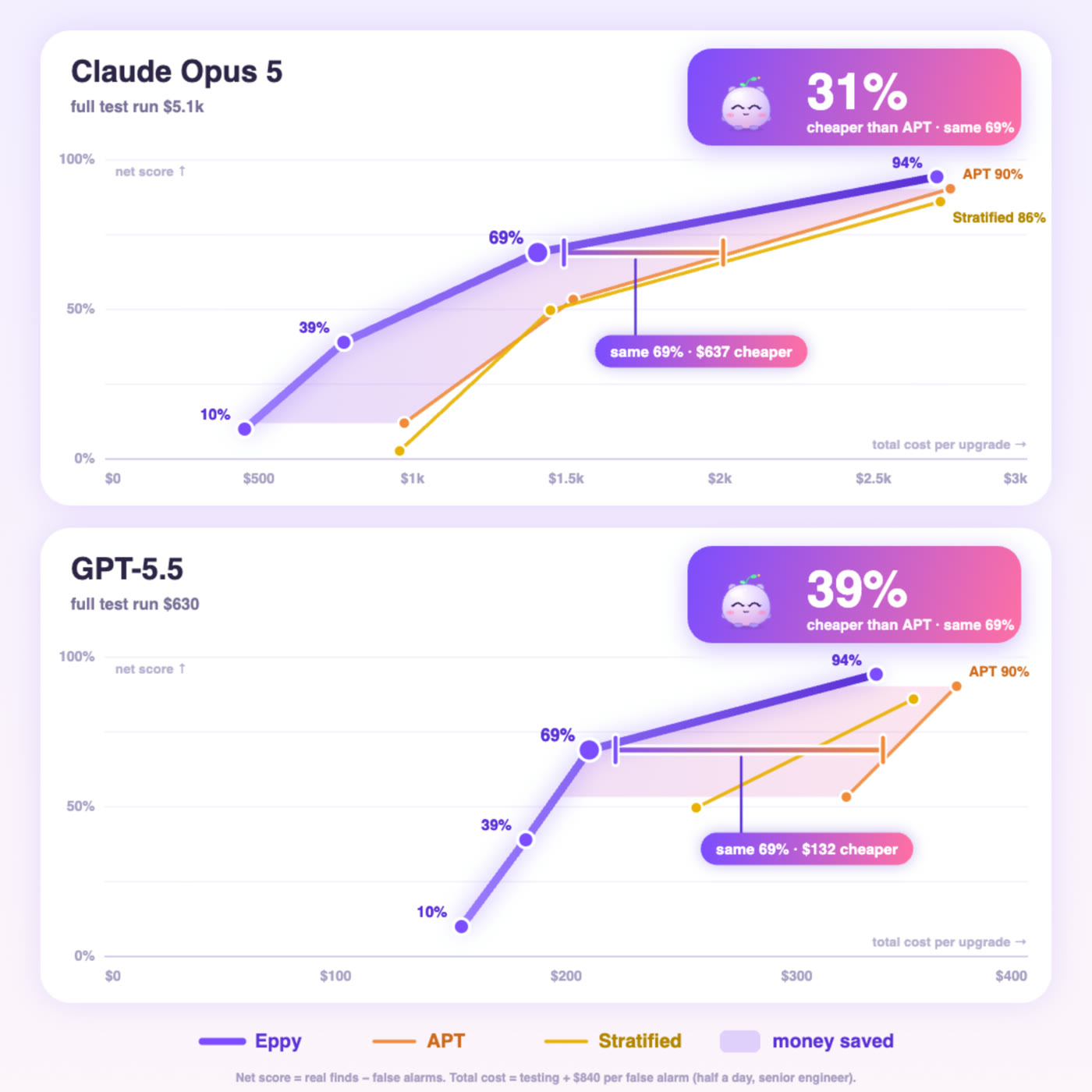
Held-out test of 10 real AI model changes (τ²-bench), 50 runs per method, priced at each model’s recorded test cost. APT’s cost at the same score is interpolated between its measured settings. APT: Locatelli et al., 2016.
Changing your AI? We’ll find what broke. myturn@ephard.ai